There are days in a home that pass quietly, almost unnoticed, folding themselves into routine. And then there are festival days; rare, luminous interruptions when the same walls begin to feel different, as if they are remembering something older than the people living inside them. Nothing in the structure changes, and yet everything does. Space becomes charged with anticipation. Air feels fuller. Time slows just enough to be felt.
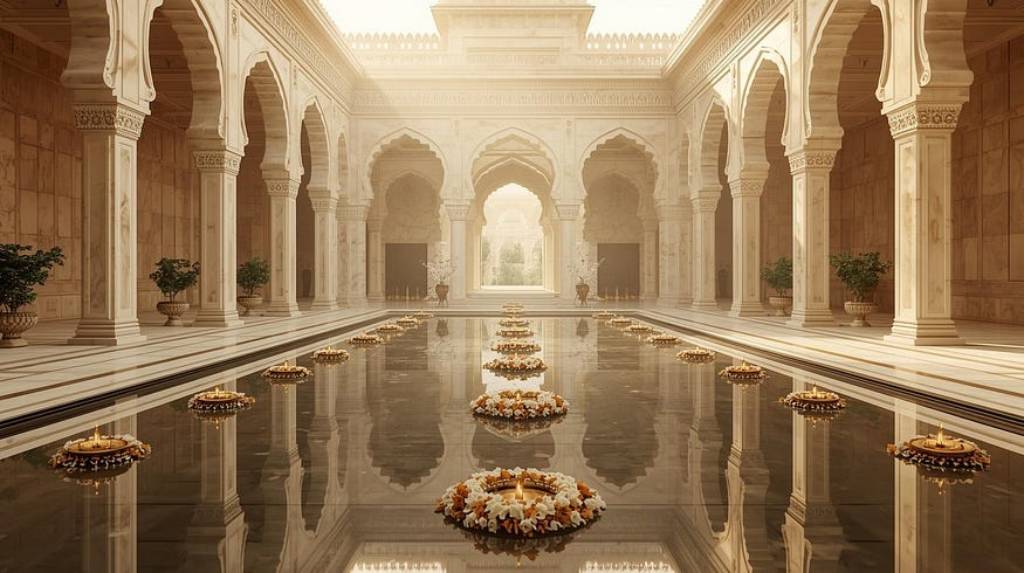
In homes shaped by great wealth, festivals are not louder; they are deeper. The celebration does not rely on excess display but on careful continuity. Light arrives first, soft rows of lamps along long corridors, reflections trembling across polished stone, warm illumination settling gently into corners that usually remain still. Illumination here is not decoration. It is invitation. It signals that the house is preparing to hold more life than usual.
Then comes fragrance, moving quietly through rooms before any voices do. Spices warming in distant kitchens, flowers opened before sunrise, incense dissolving into ceilings that have witnessed many such mornings. Scent becomes the first memory written into the day, subtle but persistent, something that will return years later without warning. In this way, the house begins to record the festival even before people gather.
Food follows, not merely as abundance but as rhythm. Trays are placed in familiar sequences. Recipes repeated with almost ceremonial precision. Hands moving in gestures learned across generations. In luxury homes, the kitchen during festivals feels less like a workspace and more like a quiet theatre of continuity where memory is preserved not in photographs, but in taste, timing, and repetition. What is being prepared is not only a meal, but recognition. Proof that the past is still welcome here.
Voices change the architecture next. Corridors that usually carry silence begin to carry laughter. Large rooms, designed for calm, soften under conversation. Even distance inside expansive homes feels different when filled with shared presence. Sound does not echo in the same way; it settles, absorbed by fabrics, wood, and time. The house does not resist the noise. It receives it.
Children move differently these days. Their footsteps are quicker, their curiosity less contained. They do not yet understand ritual, but they understand energy. For them, the home during a festival feels larger, brighter, almost magical, though nothing visible explains why. Years later, they will not remember the exact décor or the precise arrangement of objects. They will remember the feeling of being gathered. Of belonging without question.
Elders move more slowly, but with a quiet certainty. Festivals return them to earlier versions of the same rooms, rooms filled with people who are no longer present, voices that survive only in memory. In moments of stillness, celebration and absence coexist gently. This is the hidden tenderness of festival homes: joy that makes space for remembrance without announcing it.
Repetition is what transforms celebration into memory. The same lights each year. The same doorway where greetings happen. The same table where everyone eventually gathers, regardless of distance or disagreement. Architecture becomes meaningful not because of scale or material, but because of recurrence. What happens again and again begins to feel permanent, even if nothing truly is.
By evening, the house reaches a different quiet. Not the ordinary silence of routine, but a softened stillness after fullness. Lamps burn lower. Conversations thin into whispers. Dishes are cleared, yet traces remain, warmth in the air, faint fragrance, the subtle disorder that proves life has passed through. This closing quiet is part of the ritual too. Without it, the day would feel unfinished.
And somewhere between the first light of morning and the final dim glow of night, the home has changed briefly and invisibly. It has held more memory than usual. It has carried laughter, longing, continuity, and time, all at once. Nothing in its design records this transformation, yet everything within it remembers.
This is the secret of homes during festivals, especially those built with immense care and quiet luxury: celebration is not contained in decoration or scale. It lives in repetition, presence, and shared return. For a few luminous hours, space stops being architecture and becomes belonging in real time.
And long after the lights are put away. The house keeps the memory,
waiting patiently for the next year to arrive.