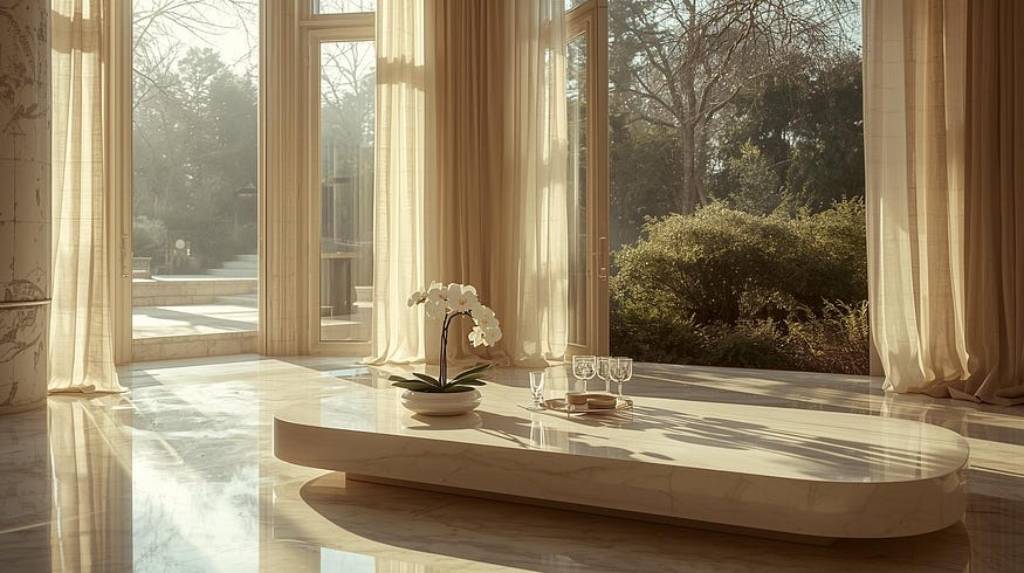
There is a particular moment after guests leave that rarely gets described. It arrives quietly, without announcement. Doors close, footsteps fade, and conversations dissolve into memory. The house, which only hours earlier held movement, laughter, and layered voices, returns to stillness. Yet this stillness is not the same as the silence that existed before the gathering began.
Instead, the quiet feels heavier, warmer, and almost luminous. The space seems inhabited by what has just passed through it. Sound disappears, yet presence remains. In homes shaped with care and quiet luxury, this transition becomes deeply perceptible, not visually, but emotionally. The atmosphere carries a residue of connection that lingers long after people have gone.
During gatherings, architecture performs outwardly. Rooms open themselves to movement, corridors guide circulation, and tables become centres of gravity where people pause and connect. Light expands across surfaces, and materials receive touch and warmth. The home stretches to accommodate life in motion. When everyone leaves, that outward performance ends, and what remains is a more intimate truth.
Small details begin to reveal the memory of the evening. Cushions hold the imprint of where someone leaned. Glassware carries the faint echo of raised conversations. The air keeps a trace of fragrance whose source is no longer visible. Nothing dramatic has changed, yet everything feels subtly altered. The house has absorbed the experience.
This shift from shared noise to private fullness is something most homes experience, but few people consciously notice. Absence, in this context, does not create emptiness. Instead, it creates depth. In expansive and carefully designed residences, the feeling becomes even more pronounced. Scale allows silence to expand gradually, and materials soften sound rather than reject it. Long corridors slow the return to routine, creating a gentle settling rather than an abrupt quiet. Luxury, in this moment, reveals a different meaning and not display or grandeur, but the ability of space to hold emotion without collapsing into vacancy.
Those who live in such homes often recognise this hour instinctively. They move through rooms more slowly and begin to notice what gatherings truly leave behind. It is not objects, but atmosphere. Gratitude appears quietly, without needing language. The silence allows reflection to surface in a calm and unforced way.
There is also tenderness within this quiet. Every gathering carries an unspoken awareness that time is moving forward, that moments cannot be repeated in exactly the same way, and that voices heard tonight may one day exist only as memory. The stillness after guests leave allows this awareness to emerge gently, without sadness or fear.
What remains is not loneliness but completion. The house is no longer preparing, performing, or waiting. It is simply holding, holding laughter that has already happened, warmth that still lingers in the air, and the invisible proof that life passed through these rooms and left them changed, even if only for an evening.
This is the silence no one talks about. It is not empty, lonely, or cold. It is a silence that feels fuller than noise. In that fullness, the true purpose of a home becomes visible: not to impress the world or to host perfectly, but to receive life, release it gently, and remain steady enough to remember.
Long after the lights are turned off and the last door is closed, the house stays quietly awake, keeping what mattered.