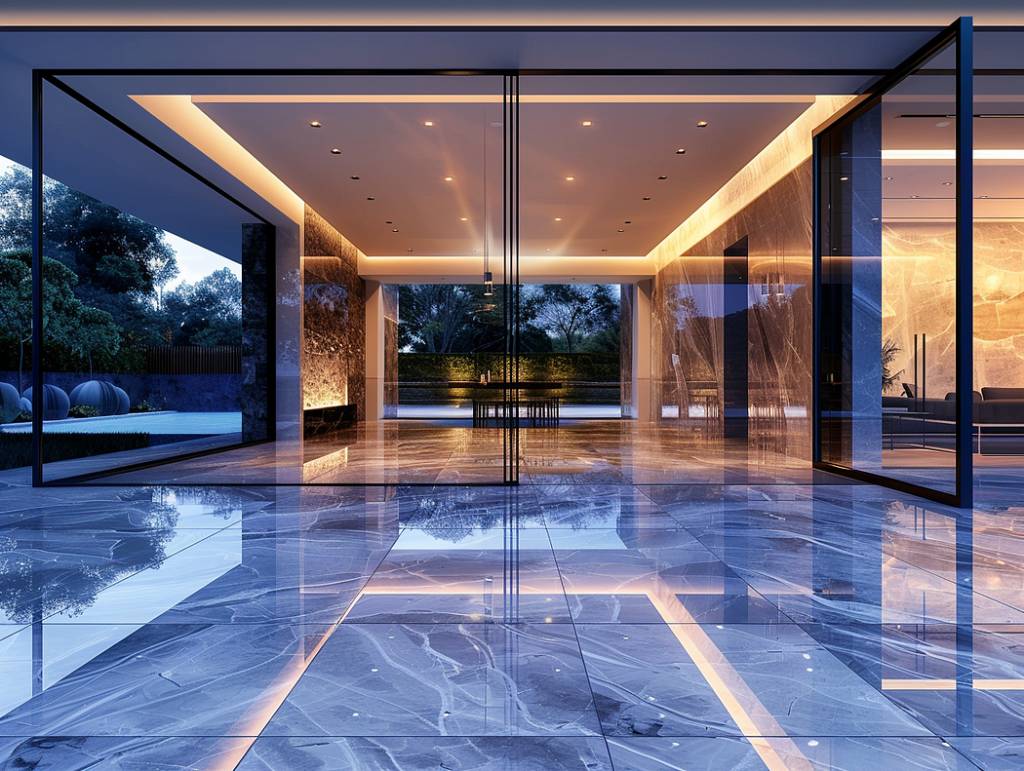
There is a moment in every home that is rarely designed with the attention it deserves. It is not the living room, nor the kitchen, nor the spaces that are photographed and discussed. It is the threshold, the point at which the outside is left behind and something else quietly begins.
We tend to think of entry as a functional transition. A door opens, a handle turns, a step is taken. But in lived experience, it is far more than that. It is a psychological shift, a recalibration of the body and mind as one environment dissolves and another takes hold.
What is often overlooked is that this transition shapes identity in subtle but persistent ways.
The moment of arrival asks a question, even if it is never spoken: who are you when you enter this space? What do you carry in with you, and what are you willing to leave behind? The threshold becomes a filter, not just a passage. It determines whether the home receives you gently or abruptly, whether it absorbs the outside world or allows it to linger.
When designed with care, this moment unfolds in layers rather than in a single gesture.
The first layer is auditory. Before anything is seen, there is a change in sound. The dulling of the street, the softening of echoes, the subtle quiet that signals enclosure. This is not silence as absence, but silence as presence, something that can be felt as much as heard.
Closely following this is a shift in temperature. The air settles differently, often imperceptibly, but enough to register. Warmth or coolness is not simply a matter of comfort; it is a cue that the environment has changed. The body responds before the mind has time to interpret.
Then comes the tactile dimension, perhaps the most immediate of all. The feel of the floor underfoot, the weight and resistance of the door, the texture of a wall or handle encountered in passing. These are not decorative decisions. They are the first physical conversations the home has with its occupant.
Together, these elements form a script, one that is experienced repeatedly, often unconsciously, but with lasting effect.
Yet in many homes, this script is fragmented or entirely absent. The entry is compressed into a purely functional zone, stripped of its potential to mediate between worlds. The result is a kind of abruptness, where the external and internal collide rather than transition.
In contrast, a well-considered threshold introduces pause.
It creates a moment, however brief, where the act of entering becomes intentional. Not slowed to the point of inconvenience, but given just enough space to be felt. This pause allows the body to recalibrate, to register that something has shifted.
It is within this pause that comfort begins.
Comfort, in this sense, is not the result of furnishings or finishes deeper within the home. It begins at the point of entry, where the environment signals that it is ready to receive. When this signal is absent, no amount of refinement in the interior can fully compensate.
There is also a symbolic dimension to this moment that is often underestimated.
What you choose at the threshold, materials, proportions, the weight of the door, the quality of light; becomes a kind of promise. It sets an expectation for what lies beyond. If the entry is resolved, the rest of the home is approached with trust. If it is unresolved, a subtle doubt persists.
In this way, the threshold is not separate from the home’s narrative. It is its beginning.
For architects and designers, this presents both a challenge and an opportunity. The challenge lies in resisting the tendency to treat entry as a leftover space, something to be resolved after more visible areas have been designed. The opportunity lies in recognizing it as one of the most powerful touchpoints in the entire experience of the home.
This is where detailing becomes critical.
Door hardware, for instance, is often approached as a specification, something to be selected for durability or aesthetic compatibility. But at the threshold, it takes on a different role. The handle is the first point of contact, the moment where intention becomes action. Its weight, its temperature, its response to touch all contribute to how arrival is felt.
Similarly, the junction between materials, the meeting of exterior and interior surfaces; carries more significance than it might elsewhere. It is here that continuity or contrast is most keenly perceived. A misalignment, however minor, can disrupt the sense of transition. A well-resolved junction, on the other hand, reinforces it.
Lighting, too, plays a subtle but decisive role.
An entry that is overly bright can feel exposed, while one that is too dim can feel uncertain. The balance lies in creating a gradient; a shift from the conditions outside to those within. Light becomes a guide, not a statement, leading the occupant inward without demanding attention.
When these elements are considered together, the threshold begins to function as intended and not as a boundary, but as a bridge.
It allows arrival to feel complete.
It allows departure to feel deliberate.
And it anchors the experience of the home in a way that persists long after the moment itself has passed.
Ultimately, the threshold is not about movement from one space to another.
It is about transformation.
A well-designed home understands that this transformation does not happen automatically. It must be supported, shaped, and given form. And when it is, the simple act of entering becomes something far more meaningful.
Not just a step inside, but the beginning of belonging.