It usually happens without ceremony.
The door opens, the luggage is dropped, and shoes are slipped off almost unconsciously. The body is still carrying the day, the noise, the pace, the small accumulations of tension that haven’t yet found a place to settle. Nothing has changed immediately. The outside has followed you in.
And yet, within seconds, something begins to shift. Not visually, not dramatically, but physically.
The first contact is not with a room, or a piece of furniture, or even light. It is with the floor. A simple, repeated action like stepping forward, but one that quietly determines how arrival is felt. The body does not wait for instruction. It registers the surface instantly.
The temperature is different.
Cooler, often. Stable. Unaffected by what came before. The surface holds its own condition, independent of the outside world, and in doing so, it begins to slow the body down. There is no urgency in it, no variation, no response to the pace that was carried in.
And because of that, the body adjusts.
The feet settle more fully. The weight shifts differently. The shoulders begin to release without intention. Breath deepens slightly, not as a conscious act, but as a response. The floor does not change the moment, it absorbs it.
What is striking is how immediate this is.
There is no decision to relax, no deliberate transition. The shift happens through contact alone. Through temperature, through texture, through the quiet consistency of something that does not react, but simply holds.
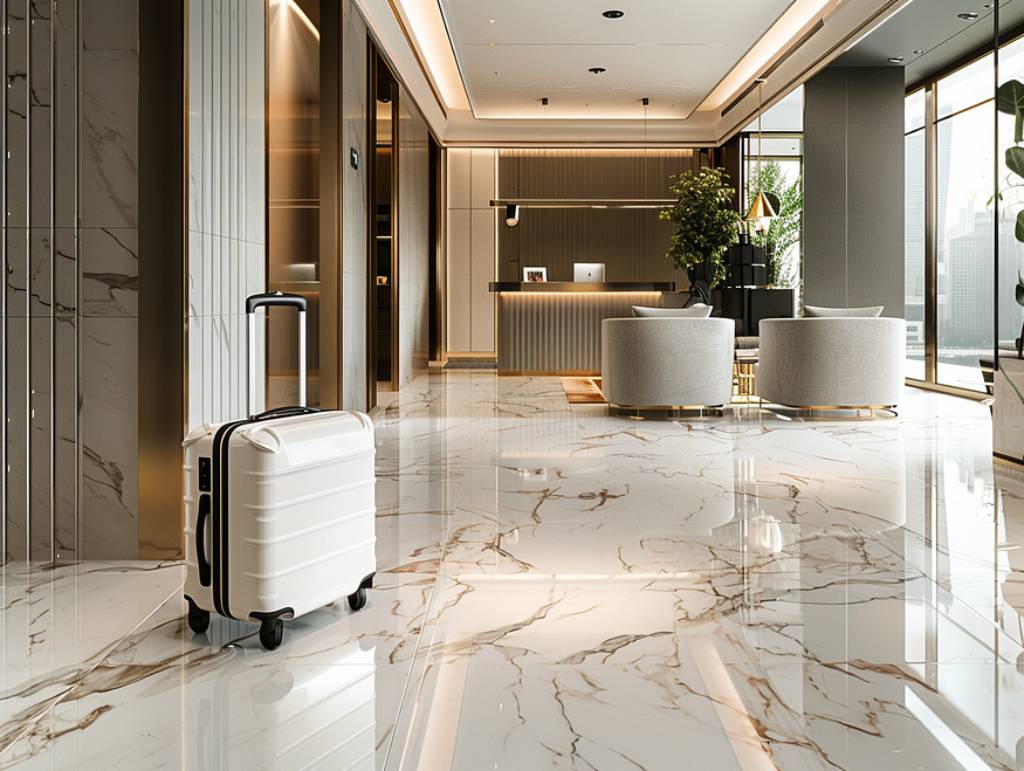
The suitcase remains by the door.
Unopened, still carrying movement within it. It becomes a quiet counterpoint to what is happening elsewhere. One part of the experience is still in motion, while another has already begun to rest. The contrast is subtle, but it defines the moment.
This is where arrival truly begins.
Not when the door closes, but when the body finds something stable enough to release onto. And in many homes, this moment is accidental. The transition is immediate, uninterrupted, and the outside continues inward without resistance.
But when this first surface is considered, when its role is understood as more than functional, the experience changes.
The home begins to receive you.
A Quiet Sequence of Arrival
Drop — what you carried arrives before you do
Touch — the body meets something constant
Release — tension begins to leave without effort
From here, everything else follows more easily.
The movement into the home becomes slower, more grounded. The mind begins to catch up with what the body has already registered. The space feels quieter, not because it is silent, but because something within you has softened.
This is where the meaning of material shifts.
The floor is no longer just a surface that connects rooms. It becomes the first point of contact between the home and the body. Its role is not visual, but physiological. It determines whether arrival feels abrupt or absorbed, whether the outside lingers or begins to fall away.
This is difficult to measure.
It cannot be captured in specifications or visual references. It is experienced in real time, in moments that are not consciously observed but deeply felt. And because of that, it is often overlooked.
But it is also where luxury quietly exists.
Not in what is seen, but in what is registered without effort. In how quickly the body begins to settle. In how naturally stillness emerges from what was previously movement.
Over time, this moment becomes familiar.
You begin to anticipate it without thinking. The act of removing your shoes becomes part of a larger sequence. The first step inside carries an expectation, not of appearance, but of feeling. The home begins to hold you before you are fully aware of it.
And this repetition builds trust.
Not in a conscious way, but in the body’s memory. The floor becomes a constant, something that does not change from day to day, something that receives you in the same way each time. And in that consistency, a deeper form of comfort is created.
The suitcase will eventually be opened.
Its contents unpacked, its purpose resolved. But the feeling of that first moment, the quiet transition from movement to stillness, will remain. It will repeat, again and again, each time you return.
And that is where the meaning of home is formed. Not in what is arranged or displayed, but in what is felt without effort. In the moments that require no attention, yet shape the entire experience.
Sometimes, it begins with something as simple as a floor. And the way it knows how to hold you.