
The trucks arrived just after sunrise, long before the rest of the construction site had found its rhythm. The air still carried the coolness of the night, and the unfinished house stood quietly against the morning light, waiting for another piece of itself to arrive. Workers gathered near the entrance, conversations softer than usual, not because anyone had been instructed to be careful, but because everyone understood what was inside the wooden crates. This was not simply another delivery. It was the arrival of something that had already been imagined months earlier, chosen with extraordinary patience and entrusted to complete one of the home’s most important stories.
For anyone unfamiliar with luxury residential construction, the arrival of natural stone may appear no different from the delivery of any other building material. A truck reverses carefully into position, cranes begin lifting heavy crates, logistics teams coordinate movements and supervisors inspect paperwork before unloading begins. Yet beneath these ordinary actions lies a quiet emotional significance. Everyone present knows that the object being delivered is not merely marble or quartzite. It is the exact slab that a family once stood beside in a distant stone gallery, imagining how morning light would travel across its surface, where children would eventually place their schoolbags and where years of conversations would quietly unfold.
Luxury architecture is filled with moments that outsiders rarely notice because they happen before the completed house ever exists. We celebrate finished interiors, elegant photography and carefully styled living rooms, but the emotional milestones of a project often occur much earlier. The day a client recognises the right slab. The first time architectural drawings are placed beside the stone. The final approval before fabrication begins. And perhaps most quietly of all, the morning that same slab finally arrives at the home it was always intended to become part of. These moments never appear in magazines, yet they shape every image that eventually does.
There is something remarkably reassuring about continuity in a world increasingly defined by substitution. Luxury, at its highest level, is not simply about rarity or expense. It is about promises being kept. The slab selected months earlier is not replaced because another piece appears similar. It is tracked, documented, transported and protected so that the exact material admired during selection becomes the exact material installed inside the home. This continuity creates trust. It tells homeowners that every decision they made has been respected from quarry to construction site without compromise.
Achieving this level of continuity requires far more than careful transportation. It demands extraordinary coordination between quarry operators, logistics specialists, project managers, fabricators and installers, each understanding that they are not merely moving stone but protecting intention. Every crate carries identification numbers matched to fabrication drawings. Protective timber framing absorbs movement during transport. Moisture levels are monitored. Lifting equipment is positioned to prevent unnecessary stress on the material. The arrival appears calm because countless invisible decisions have already eliminated uncertainty long before the truck reached its destination.
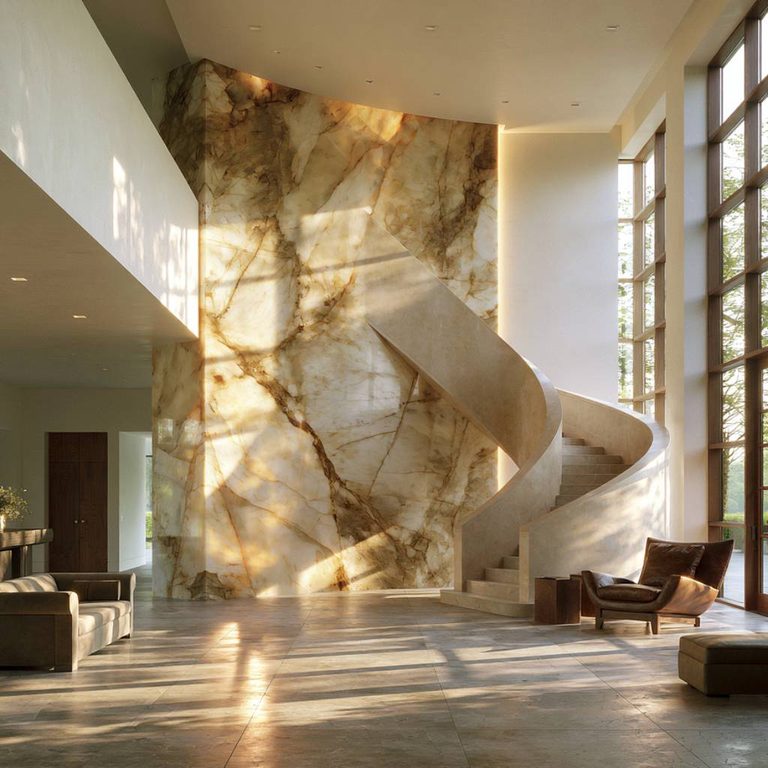
Perhaps this is why experienced project managers rarely describe these deliveries as routine. They understand that replacing a damaged slab is not always possible. Natural stone is unlike manufactured products that can simply be reordered. Every slab possesses a geological identity formed over millions of years. The movement of a Calacatta vein, the crystalline depth of Sodalite Blue, the translucent warmth of Cristallo Quartzite or the layered landscape within Patagonia Quartzite can never be duplicated precisely. If continuity is lost, something irreplaceable disappears with it. Logistics therefore becomes an extension of craftsmanship rather than a separate operation.
Standing before the unopened crate, there is always a brief pause. It lasts only seconds, yet it contains months of anticipation. The protective timber is removed carefully. Layers of wrapping disappear one by one. Dust from the journey settles quietly onto the construction floor. Then the stone finally appears, unchanged from the day it was first selected. Familiar veins emerge exactly where memory expected them to be. The architect smiles almost instinctively. The homeowner recognises the surface immediately. No explanation is necessary because recognition arrives before words.
That moment reveals something profoundly human. We often think architecture begins when materials are installed, but emotionally it begins much earlier. It begins when people recognise something that already feels like home, even while standing inside a warehouse thousands of kilometres away. The arrival of the slab simply reconnects two moments that were separated by distance and time. Selection becomes reality. Imagination becomes construction. The house takes another quiet step towards becoming a place where memories will eventually outnumber drawings.
The greatest luxury homes understand that emotional continuity matters just as much as structural precision. Clients rarely remember every technical specification discussed during construction, yet many remember exactly where they were standing when the selected stone first arrived on site. They remember seeing the same movement within the marble that had first captured their attention months earlier. They remember the reassurance that nothing had changed. That memory becomes woven into the life of the home itself, transforming architecture into something deeply personal rather than merely impressive.
By the afternoon, the slab is safely stored, awaiting fabrication. The trucks have already departed. Construction resumes its familiar pace. Hammers, conversations and machinery once again fill the site. Yet something subtle has shifted. The building no longer feels like a collection of unfinished spaces waiting for materials. It feels like a home that has just welcomed one of its oldest companions.
The delivery is over. The belonging has only just begun.
The finest homes are not built when materials arrive, they are built the moment every promise made to them quietly arrives as well.